- How would you describe your learning in this course so far?
I would describe my learning this semester as collaborative. Being a part of a research team has helped me read deeper into the peer-reviewed articles I found and my research findings. It’s helpful for me to have a small group to bounce my ideas off of and guide my thinking. By sharing our work, I have been able to refine my literature review, data collection survey questions, and analysis methods. Additionally, collaborating on a research team is beneficial because it gives me experience coming to a consensus in an academic setting. I feel coming to consensus can be one of the most challenging parts of working as a team, especially when writing as a group. I feel our teamwork has taught me more about being honest, yet sensitive and respectful to other’s writing and ideas in order to reach agreements about how our research fits together. These skills are easily applied to our professional settings because they are essential behaviors for emerging leaders. Without a doubt, I am using the same goal-oriented approach to collaborating with my teaching partners.
- How has your learning been meaningful and impactful either professionally or personally?
My understanding of the importance of art education has increased greatly this semester. I have always thought integrating art into my teaching was important because it encouraged creativity and increased students’ engagement. I have realized it’s deeper than that. Engaging with art challenges students to be vulnerable by sharing themselves with their peers. It requires students to take emotional risks, but the rewards are worth it. One of the greatest benefits to students is increased self-esteem and confidence, but I’ve learned many of my students are not experiencing this benefit. Because engaging with art requires emotional risk, I’ve learned how important it is for teachers to be intentional and thoughtful in how they integrate art in their lessons and create a culture of appreciation so students feel safe enough to take those risks in sharing their talent and parts of their identity. Without a calculated plan for integrating art, teachers may not be maximizing the benefits of engaging with art and possibly setting kids up for a situation in which they feel less than. From my research project, I have learned many students at my school do not feel confident and secure when sharing their creative works with their peers. This tells me I need to do a better job promoting confidence and creativity at the same time. In my tenth action research critique, the article “Promoting Creativity in the Middle Grades Language Arts Classroom” recommends four principles for promoting creativity that I feel compliment promoting confidence as well.
- Create a classroom climate that values difference, not sameness
- Value creativity
- Active, purposeful, and collaborative learning
- Use multiple ways of knowing
The first and fourth principle mesh very well with confidence building because those principles acknowledge, accept, and appreciate diverse ways of thinking.
Additionally, my learning from the article “ “Becoming Somebody!” pairs well with the research on promoting creativity. In “Becoming Somebody!,” Holloway and LeCompte (2001) write about how an artist’s toolkit is created through critique and collaboration. Ideally, the toolkit includes centering, open-mindedness, and self-expression. By combining my learning about the artist’s toolkit and the principles for promoting creativity, I feel I am more prepared to create an environment in which students feel safe taking emotional risks like sharing their creative works.
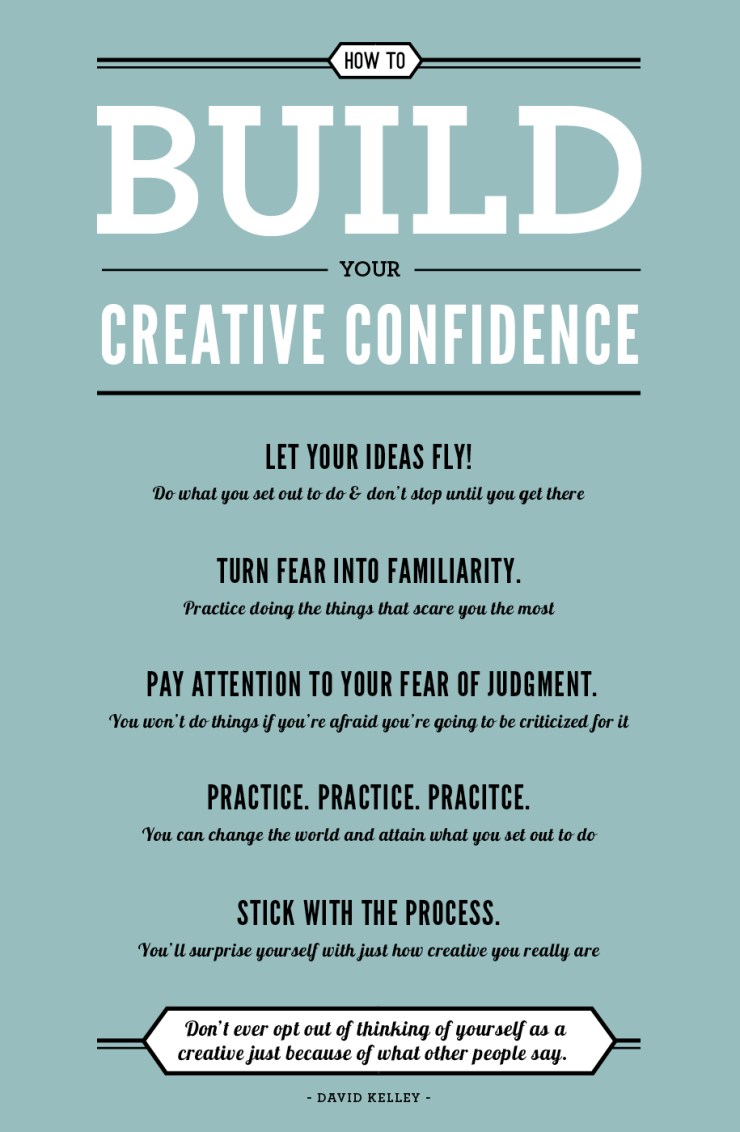
The TED Talk from David Kelley provides an additional perspective on developing creative confidence. His introductory example about his third-grade school experience is one most of us can personalize. I imagine it is the same rejection my students experience and seek to avoid when engaging with art. I found this image from David Kelley outlining practices we can all put into place to inspire others and yourselves to build our creative confidence.
 Wes Akers
Wes – What I appreciate about this Research Reflection, and what I’ve consistently admired about your work in our various courses, is your grounding in day-to-day learning opportunities for your students. Yes, you have come to appreciate aspects of research generally, and action research more specifically. And yet you’re always looking for the relevance to your pedagogy and your students’ learning. Yes, you’ve developed very strategic and useful teamwork strategies with Susannah and La Dawna, and yet I know these collaborations are reflected in how you want your own students to work together. And yes, you’re also learning quite a bit about the content, advantages, and “state of art” (yes, pun intended) about arts engagement and education. Yet again, it’s your students who are ultimately the true beneficiaries. As you write, “I feel I am more prepared to create an environment in which students feel safe taking emotional risks like sharing their creative works.” Your commitments to pedagogy and equity shine through, and I’m pleased that the action research activities of this course are so relevant to your current teaching. Thanks for sharing!
LikeLike