As I refine and focus my research process, I am drawn to research about content area classroom teachers using public art in their classrooms because I feel like this is a gap in my research. With this idea in mind, I found the article “Social Studies Education and Public Art” by Julie Anne Taylor and Okezie Iroha. They studied high school social studies classrooms in Detroit and set out to answer the research questions below.
- What impact would involvement in a community-oriented, art-based project in social studies have on high school students?
- Would the possibility of a public display of student artwork be motivational?
- In the eyes of high school students in Detroit, what are the most compelling community issues?
- How important to high school students is having the opportunity to convey their views publicly?
- How do high school students think that they can address community issues?
The teachers designed a service learning project integrating persuasive writing, community issues, and public art. The summative assessment of the unit required students to create a billboard about a community issue using persuasive techniques and art. To reach this goal, the unit was divided into four stages.
- Students identified community issues.
- Students studied art’s potential to inform and persuade community members.
- Students created billboard designs demonstrating their understanding of persuasive techniques, art, and community issues.
- Students vote to select the billboard design they believe best met the unit requirements.
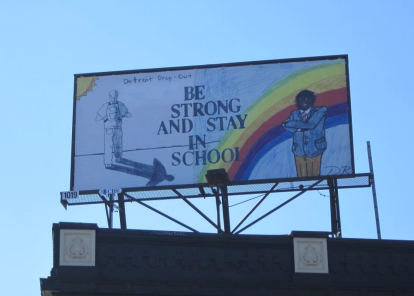
I am drawn to this article because the instructional unit allows students to make meaningful real-world connections. In education, I hear teachers use the word “meaningful” often to describe students’ learning experiences, but I feel like the descriptor can be too ambiguous and non-specific. This unit exemplifies a meaningful learning experience because it requires students to connect with their community, engage with art, and practice critical literacy skills. When participating students were interviewed by Taylor and Iroha, their responses proved this unit to be meaningful and the teachers were successful in reaching their goals.
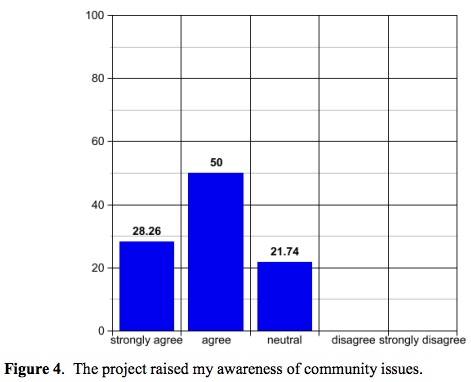
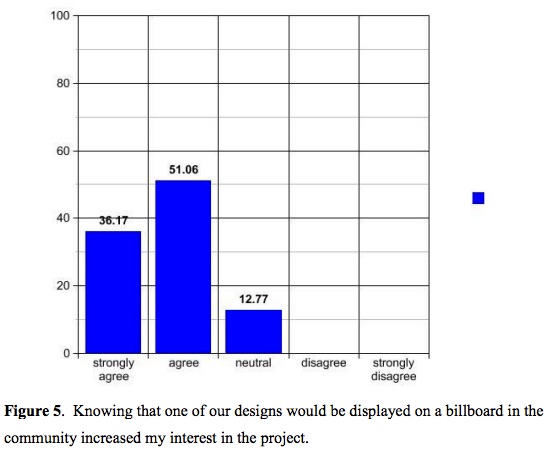
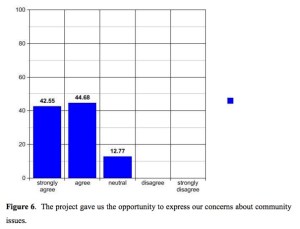
As illustrated by the graphs above, Taylor and Iroha (2015) used a five-point Likert scale when surveying participating students. Additionally, they included opened questions on the survey that they qualitatively analyzed. When analyzing the responses to the open-ended questions, Taylor and Iroha (2015) used “the constant comparison data analysis strategy” (p. 7).
They…
- Read the responses several times.
- Engaged in open coding by identifying common concepts among responses.
- Grouped common concepts revealed major themes.
- Continuously revisited the responses and quantitative data to validate themes.
Again, it is helpful to observe another example of researchers’ coding process. With this article, my big take away is to continuously revisit participants’ responses. I think this will be important for me to analyze the data on different days. Using just one day to analyze the data may unintentionally create a biased analysis process. When I write or engage in challenging thinking, I need to take breaks, give myself some space from the work, and then go back to analyze my work. It allows me to come at my ideas with a fresh mind which I think will help me eliminate bias from my analysis process.
Taylor, J. A., & Iroha, O. (2015). Social studies education and public art: The detroit billboard project. Journal of Social Studies Education Research, 6(1), 1-25.
 Wes Akers
Leave a comment