I found the article, “Going on Beyond Zebra” by Beth Krensky formerly from the University of Colorado Boulder, for my third critique when I found the article for my second critique using the Auraria Library’s databases. To find the article, I used the search terms “middle school,” “public art,” and “identity.”
I selected this article for the same reasons I selected the previous two articles; because it is focused on how arts education programs impact adolescent learners. My group is interested in how the engaging with arts in schools impact a learner’s identity development. In the two previous articles, the researchers were focused on students’ motivation, engagement (Moorefield-Lang, 2010), and confidence (Holloway and LeCompte, 2001). The aspects of student identity Krensky (2001) observe include awareness, envisioning, and efficacy. Once I read this part of the article, I knew I made a good selection because I started to envision an answer to a question I have had for a while – what makes up student identity? And more specifically, what components of identity are impacted by art? With each article I read, I am discovering different aspects of identity that art can positively impact. I started to brainstorm some of the big ideas I’m envisioning as I continue to read.
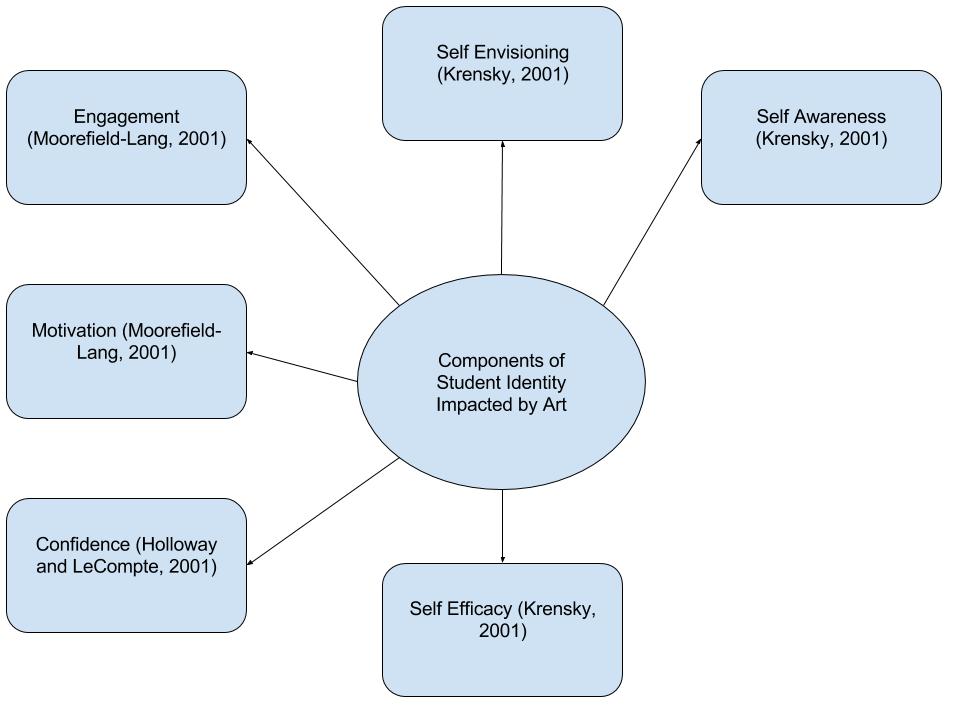
Action Research
Similar to Holloway and LeCompte (2001), Krensky also does not ask a lot of questions but instead makes claims about how to address problems of racial and socioeconomic inequality in a small Colorado city, Minersville. Krensky (2001) claims “the arts provide a powerful way for young people to explore, engage in, and affect social issues” as well as “envision different possibilities for themselves and their community.” Krensky (2001) proves this claim by observing the impact creating and implementing a program called the Peace Park Project had on the Minersville community. The Peace Park Project was created to design a recreational and artistic space for adults and youth of a mobile home community. Krensky (2001) explores the role 60 sixth grade students at Lewis Middle School played in creating and implementing the project. The sixth-grade teachers at Lewis MS designed an integrated service learning unit around the Peace Park Project. As I read more about the project, I keep thinking that this is what action research looks like. The project was addressing a specific problem in a local community and involved a variety of stakeholders in the decision-making process. Most importantly, the project was the product of the participants’ action.
Data Collection Methods
Additionally, Krensky (2001) identifies herself as an action researcher when she begins to describe her data collection methods and findings. Her field notes, pre and post questionnaires, and interviews are her sources of data. Students, teachers, and parents participated in the questionnaires and interviews. It makes me feel more confident to observe another action researcher using the same means of data collection that I plan to use.
Findings
Although Krensy (2001) does not explain how she evaluated her the questionnaires and interviews to find common trends, I think she used qualitative analysis to synthesize the three themes awareness, envisioning, and efficacy. When Krensy (2001) explains her findings on awareness, she emphasizes the data collected from the pre-project and post-project questionnaires. She noticed students were more detailed and had a lot more to write on the post-project questionnaire. To me, this is an indicator of meaningful data because students were able to produce thoughtful and descriptive commentary about their experience. Overall, the findings most relevant to my research focus on how arts programs designed around local, social issues
- increase students’ awareness and understanding of complex problems facing their community and the role they can play to help solve them.
- help students envision what they want for the future of their community and they role they play in making the change.
- encourage a stronger sense of self-efficacy because students made an actual, tangible impact in their community.
Krensky, B. (2001). Going on beyond Zebra: A Middle School and Community-Based Arts Organization Collaborate for Change. Education And Urban Society, 33(4), 427–444.
 Wes Akers
Leave a comment